China
From Wikipedia, the free encyclopedia
This article is about the People's Republic of China. For the Republic of China, see Taiwan. For other uses, see China (disambiguation).
"PRC" redirects here. For other uses, see PRC (disambiguation).
People's Republic of China
| ||||||
|---|---|---|---|---|---|---|
| ||||||
Anthem:
| ||||||
.svg)
Area controlled by the People's Republic of China shown in dark green; claimed but uncontrolled regions shown in light green.
| ||||||
| Capital | Beijing[a] 39°55′N 116°23′E | |||||
| Largest city | Shanghai[1] | |||||
| Official languages | Standard Chinese[2][b] | |||||
| Recognised regional languages | ||||||
| Official written language | Vernacular Chinese | |||||
| Official script | Simplified Chinese[2] | |||||
| Ethnic groups | ||||||
| Demonym | Chinese | |||||
| Government | Socialist single-party state[4] | |||||
| - | President | Xi Jinping[d] | ||||
| - | Premier | Li Keqiang | ||||
| - | Congress Chairman | Zhang Dejiang | ||||
| - | Conference Chairman | Yu Zhengsheng | ||||
| - | President of theSupreme People's Court | Zhou Qiang | ||||
| Legislature | National People's Congress | |||||
| Formation | ||||||
| - | First Unification of China under the Qin Dynasty | 221 BCE | ||||
| - | Republic established | 1 January 1912 | ||||
| - | People's Republic proclaimed | 1 October 1949 | ||||
| Area | ||||||
| - | Total | 9,596,961 km2[e](3rd/4th) 3,705,407 sq mi | ||||
| - | Water (%) | 0.28%[f] | ||||
| Population | ||||||
| - | 2015 estimate | 1,376,049,000[9] (1st) | ||||
| - | 2010 census | 1,339,724,852[10](1st) | ||||
| - | Density | 2013 :[11] 145/km2(83rd) 373/sq mi | ||||
| GDP (PPP) | 2015 estimate | |||||
| - | Total | $18.976 trillion[12](1st) | ||||
| - | Per capita | $13,801[12] (87th) | ||||
| GDP (nominal) | 2015 estimate | |||||
| - | Total | $11.212 trillion[12](2nd) | ||||
| - | Per capita | $8,154[12] (75th) | ||||
| Gini (2012) | 55.0[13][14] high | |||||
| HDI (2013) |  0.719[15] 0.719[15]high · 91st | |||||
| Currency | Renminbi (yuan)(¥)[g](CNY) | |||||
| Time zone | China Standard Time(UTC+8) | |||||
| Date format | ||||||
| Drives on the | right[h] | |||||
| Calling code | +86 | |||||
| ISO 3166 code | CN | |||||
| Internet TLD | ||||||


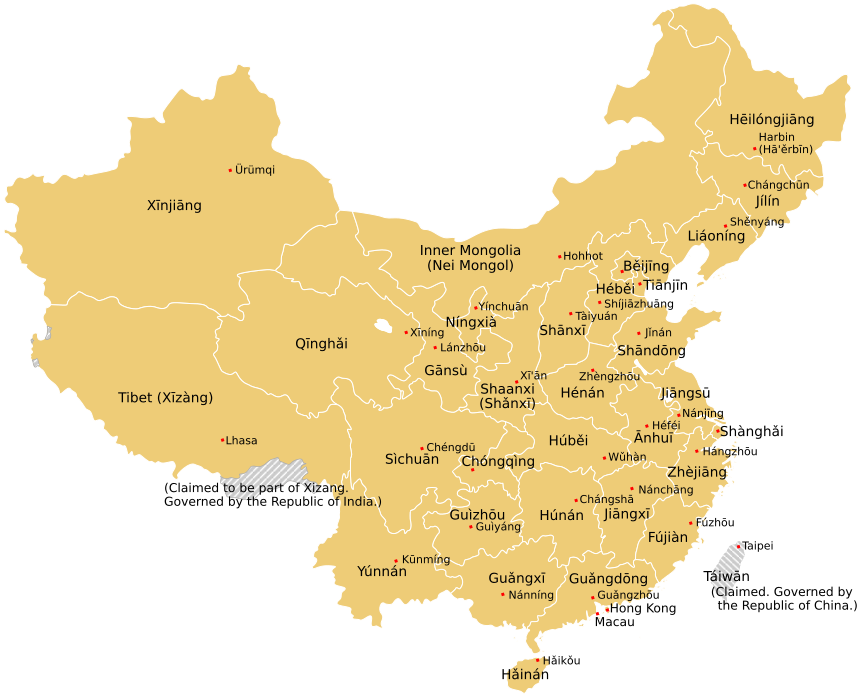
China, officially the People's Republic of China (PRC), is a sovereign state in East Asia. It is the world's most populous country, with a population of over 1.35 billion. The PRC is a single-party state governed by the Communist Party of China, with its seat of government in the capital city ofBeijing.[16] It exercises jurisdiction over 22 provinces, five autonomous regions, four direct-controlled municipalities (Beijing, Tianjin, Shanghai andChongqing), and two mostly self-governing special administrative regions (Hong Kong and Macau). The PRC also claims the territories governed by the Republic of China (ROC), a separate political entity today commonly known as Taiwan, as a part of its territory, which includes the island of Taiwan as Taiwan Province, Kinmen and Matsu as a part of Fujian Province and islands the ROC controls in the South China Sea as a part ofHainan Province. These claims are controversial because of the complex political status of Taiwan.[17]
Covering approximately 9.6 million square kilometers, China is the world's second-largest country by land area,[18] and either the third or fourth-largest by total area, depending on the method of measurement.[i] China's landscape is vast and diverse, ranging from forest steppes and the Gobiand Taklamakan deserts in the arid north to subtropical forests in the wetter south. The Himalaya, Karakoram, Pamir and Tian Shan mountain ranges separate China from South and Central Asia. The Yangtze and Yellow Rivers, the third- and sixth-longest in the world, run from the Tibetan Plateauto the densely populated eastern seaboard. China's coastline along the Pacific Ocean is 14,500 kilometres (9,000 mi) long, and is bounded by theBohai, Yellow, East and South China Seas.
China is considered a cradle of civilization, with its known history beginning with an ancient civilization – one of the world's earliest – that flourished in the fertile basin of the Yellow River in the North China Plain. For millennia, China's political system was based on hereditary monarchies, known asdynasties, beginning with the semi-mythological Xia of the Yellow River basin (c. 2800 BCE). Since 221 BCE, when the Qin Dynasty first conquered several states to form a Chinese empire, the country has expanded, fractured and been reformed numerous times. The Republic of China (ROC) overthrew the last dynasty in 1911, and ruled the Chinese mainland until 1949. After the surrender of the Empire of Japan in World War II, the Communist Party defeated the nationalist Kuomintang in mainland China and established the People's Republic of China in Beijing on 1 October 1949, while the Kuomintang relocated the ROC government to its present capital of Taipei.
China had the largest and most complex economy in the world for most of the past two thousand years, during which it has seen cycles of prosperityand decline.[19][20] Since the introduction of economic reforms in 1978, China has become one of the world's fastest-growing major economies. As of 2014, it is the world's second-largest economy by nominal total GDP and largest by purchasing power parity (PPP). China is also the world's largest exporter and second-largest importer of goods.[21] China is a recognized nuclear weapons state and has the world's largest standing army, with thesecond-largest defence budget.[22][23] The PRC has been a United Nations member since 1971, when it replaced the ROC as a permanent memberof the U.N. Security Council. China is also a member of numerous formal and informal multilateral organizations, including the WTO, APEC, BRICS, the Shanghai Cooperation Organization, the BCIM and the G-20. China is a great power and a major regional power within Asia, and has been characterized as a potential superpower by a number of commentators.[24][25]
Contents
[hide]Etymology
Main article: Names of China
| [hide]China | |||
|---|---|---|---|
| Chinese name | |||
| Simplified Chinese: | 中国 | ||
| Traditional Chinese: | 中國 | ||
| Literal meaning: | Middle Kingdom[26][27] | ||
| |||
| People's Republic of China | |||
| Alternative Chinese name | |||
| Simplified Chinese: | 中华人民共和国 | ||
| Traditional Chinese: | 中華人民共和國 | ||
| |||
| Mongolian name | |||
| Mongolian: |  | ||
| |||
| Tibetan name | |||
| Tibetan: | ཀྲུང་ཧྭ་མི་དམངས་སྤྱི མཐུན་རྒྱལ་ཁབ | ||
| |||
| Uyghur name | |||
| Uyghur: | جۇڭخۇا خەلق جۇمھۇرىيىت | ||
| |||
| Zhuang name | |||
| Zhuang: | Cunghvaz Yinzminz Gunghozgoz | ||
The word "China" is derived from the Persian word Chīn (چین), which in turn is thought to have been derived from the Sanskrit word Cīna(चीन).[28] Cīna was first used in early Hindu scripture, including the Mahābhārata (5th century BCE) and the Laws of Manu (2nd century BCE).[29]The word "China" itself was first recorded in 1516 in the journal of the Portuguese explorer Duarte Barbosa.[30] The journal was translated and published in England in 1555.[31] The traditional theory, proposed in the 17th century by Martino Martini and supported by many later scholars, is that the word China and its earlier related forms are ultimately derived from the state of "Qin" (秦), the westernmost of the Chinese kingdoms during the Zhou dynasty which unified China to form the Qin dynasty.[32] Other suggestions for the derivation of "China" however exist.[29][33]
The official name of the modern country is the People's Republic of China (Chinese: 中华人民共和国; pinyin: Zhōnghuá Rénmín Gònghéguó). The common Chinese names for the country are Zhōngguó (Chinese: 中国, from zhōng, "central" or "middle", and guó, "state" or "states", and in modern times, "nation") and Zhōnghuá (Chinese: 中华), although the country's official name has been changed numerous times by successivedynasties and modern governments. The term Zhōngguó appeared in various ancient texts, such as the Classic of History of the 6th century BCE,[j] and in pre-imperial times it was often used as a cultural concept to distinguish the Huaxia tribes from perceived "barbarians". The term, which can be either singular or plural, referred to the group of states or provinces in the central plain, but was not used as a name for the country as a whole until the nineteenth century. The Chinese were not unique in regarding their country as "central", with other civilizations having the same view of themselves.[34]
History
Main articles: History of China and Timeline of Chinese history
Prehistory
Main article: Chinese prehistory
Archaeological evidence suggests that early hominids inhabited China between 250,000 and 2.24 million years ago.[35] A cave in Zhoukoudian(near present-day Beijing) exhibits hominid fossils dated at between 680,000 and 780,000 BCE.[36] The fossils are of Peking Man, an example ofHomo erectus who used fire.[37] The Peking Man site has also yielded remains of Homo sapiens dating back to 18,000–11,000 BCE.[38] Chineseproto-writing existed in Jiahu around 7000 BC,[39] Dadiwan from 5800 BC to 5400 BC, Damaidi around 6000 BC [40] and Banpo dating from the 5th millennium BC. Some scholars have suggested that Jiahu symbol (7th millennium BC) was the earliest Chinese writing system.[39]
Early dynastic rule
Further information: Dynasties in Chinese history

According to Chinese tradition, the first dynasty was the Xia, which emerged around 2100 BCE.[41] The dynasty was considered mythical by historians until scientific excavations found early Bronze Age sites at Erlitou, Henan in 1959.[42] It remains unclear whether these sites are the remains of the Xia Dynasty or of another culture from the same period.[43] The succeeding Shang dynasty is the earliest to be confirmed by contemporary records.[44] The Shang ruled the plain of the Yellow River in eastern China from the 17th to the 11th century BCE.[45] Their oracle bone script (from c. 1200 BCE) represents the oldest form of Chinese writing yet found,[46] and is a direct ancestor of modern Chinese characters.[47] The Shang were conquered by the Zhou, who ruled between the 11th and 5th centuries BCE, though centralized authority was slowly eroded by feudal warlords. Many independent states eventually emerged from the weakened Zhou state and continually waged war with each other in the 300-year Spring and Autumn Period, only occasionally deferring to the Zhou king. By the time of the Warring States period of the 5th–3rd centuries BCE, there were seven powerful sovereign states in what is now China, each with its own king, ministry and army.
Imperial China

The Warring States period ended in 221 BCE after the state of Qin conquered the other six kingdoms and established the first unified Chinese state. Qin Shi Huang, the emperor of Qin, proclaimed himself "First Emperor" (始皇帝) and imposed reforms throughout China, notably the forced standardization of Chinese characters, measurements, length of cart axles, and currency. The Qin Dynasty lasted only fifteen years, falling soon after Qin Shi Huang's death, as its harsh legalist and authoritarian policies led to widespread rebellion.[48][49]
The subsequent Han Dynasty ruled China between 206 BCE and 220 CE, and created a lasting Han cultural identity among its populace that has endured to the present day.[48][49] The Han Dynasty expanded the empire's territory considerably with military campaigns reaching southern Korea, Vietnam, Mongoliaand Central Asia, and also helped establish the Silk Road in Central Asia. Han China gradually became the largest economy of the ancient world.[50] The Han Dynasty adopted Confucianism, a philosophy developed in the Spring and Autumn period, as its official state ideology. Despite the Han's official abandonment of Legalism, the official ideology of the Qin, Legalist institutions and policies remained and formed the basis of the Han government.[51]

After the collapse of Han, a period of disunion known as the period of the Three Kingdoms followed.[52] The brief unification of the Jin dynasty was broken by the uprising of the Five Barbarians. In 581 CE, China was reunited under the Sui. However, the Sui Dynasty declined following its defeat in the Goguryeo–Sui War (598–614).[53][54]
Under the succeeding Tang and Song dynasties, Chinese economy, technology and culture entered a golden age.[55] After the campaigns against the Turks, China returned control of the Western Regions and reopened the Silk Road during the flourishing age of Tang dynasty,[56] which was devastated and weakened by the An Shi Rebellion in the 8th century.[57] The Song dynasty was the first government in world history to issue paper money and the first Chinese polity to establish a permanent standing navy which was supported by the developed shipbuilding industry along with the sea trade.[58] Between the 10th and 11th centuries, the population of China doubled in size to around 100 million people, mostly because of the expansion of rice cultivation in central and southern China, and the production of abundant food surpluses. The Song dynasty also saw a revival of Confucianism, in response to the growth of Buddhism during the Tang,[59]and a flourishing of philosophy and the arts, as landscape art and porcelain were brought to new levels of maturity and complexity.[60][61] However, the military weakness of the Song army was observed by the Jurchen Jin dynasty. In 1127, Emperor Huizong of Song and the capital Bianjing was captured during the Jin–Song Wars, remnants of the Song retreated to southern China.[62]
.jpg)
In the 13th century, China was gradually conquered by the Mongol empire. In 1271, the Mongol leader Kublai Khan established the Yuan Dynasty; the Yuan conquered the last remnant of the Song dynasty in 1279. Before the Mongol invasion, the population of Song China was 120 million citizens; this was reduced to 60 million by the time of the census in 1300.[63] A peasant named Zhu Yuanzhang overthrew the Yuan Dynasty in 1368 and founded the Ming Dynasty. Under the Ming Dynasty, China enjoyed another golden age, developing one of the strongest navies in the world and a rich and prosperous economy amid a flourishing of art and culture. It was during this period that Zheng He led explorations throughout the world, reaching as far as Africa.[64] In the early years of the Ming Dynasty, China's capital was moved from Nanjing to Beijing. During the Ming Dynasty, philosophers such as Wang Yangmingfurther critiqued and expanded Neo-Confucianism with concepts of individualism and innate morality.[65] With the development of industry and commerce, the scholar-official stratum became a supporting force of the bud of capitalism, the scholar-official-supported tax boycott movements plus the famines and the wars against Japanese and manchu invasions led to an exhausted treasury.[66]
In 1644, Beijing was captured by a coalition of rebel forces led by Li Zicheng, a minor Ming official who led the peasant revolt. The last Ming Chongzhen Emperor committed suicide when the city fell. The Manchu Qing Dynasty then allied with Ming Dynasty general Wu Sangui and overthrew Li's short-livedShun Dynasty, and subsequently seized control of Beijing, which became the new capital of the Qing Dynasty.
End of dynastic rule

The Qing dynasty, which lasted from 1644 until 1912, was the last imperial dynasty of China. As a conquest dynasty, it strengthened the feudal autocracy to crackdown anti-Qing sentiment. The Haijin ("sea ban") and the ideological control as represented by the literary inquisition caused technological stagnation.[67][68] In the 19th century, the dynasty experienced Western imperialism following the First Opium War (1839–42) and the Second Opium War(1856–60) with Britain and France. China was forced to sign unequal treaties, pay compensation, open treaty ports, allow extraterritoriality for foreign nationals, and cede Hong Kong to the British[69] under the 1842 Treaty of Nanking. The First Sino-Japanese War (1894–95) resulted in Qing China's loss of influence in the Korean Peninsula, as well as the cession of Taiwan to Japan.[70]
The Qing dynasty also began experiencing internal unrest in which millions of people died. In the 1850s and 1860s, the failed Taiping Rebellion ravaged southern China. Other major rebellions included the Punti-Hakka Clan Wars (1855–67), the Nian Rebellion (1851–68), the Miao Rebellion (1854–73), thePanthay Rebellion (1856–73) and the Dungan Revolt (1862–77). The initial success of the Self-Strengthening Movement of the 1860s was frustrated by the series of military defeats in the 1880s and 1890s.
In the 19th century, the great Chinese Diaspora began. Losses due to emigration were added to by conflicts and catastrophes such as the Northern Chinese Famine of 1876–79, in which between 9 and 13 million people died.[71] In 1898, the Guangxu Emperor drafted a reform plan to establish a modern constitutional monarchy, but these plans were thwarted by the Empress Dowager Cixi. The ill-fated anti-Western Boxer Rebellion of 1899–1901 further weakened the dynasty. Although Cixi sponsored a program of reforms, the Xinhai Revolution of 1911–12 brought an end to the Qing dynasty and established the Republic of China.
Republic of China (1912–49)
Main articles: Republic of China (1912–49) and History of the Republic of China
See also: Taiwan and Taiwan after World War II


On 1 January 1912, the Republic of China was established, and Sun Yat-sen of the Kuomintang (the KMT or Nationalist Party) was proclaimed provisional president.[72] However, the presidency was later given to Yuan Shikai, a former Qing general who in 1915 proclaimed himself Emperor of China. In the face of popular condemnation and opposition from his own Beiyang Army, he was forced to abdicate and reestablish the republic.[73]
After Yuan Shikai's death in 1916, China was politically fragmented. Its Beijing-based government was internationally recognized but virtually powerless; regional warlords controlled most of its territory.[74][75] In the late 1920s, the Kuomintang, under Chiang Kai-shek, the then Principal of the Republic of China Military Academy, was able to reunify the country under its own control with a series of deft military and political manoeuvrings, known collectively as the Northern Expedition.[76][77] The Kuomintang moved the nation's capital to Nanjing and implemented "political tutelage", an intermediate stage of political development outlined in Sun Yat-sen's San-min program for transforming China into a modern democratic state.[78][79] The political division in China made it difficult for Chiang to battle the Communists, against whom the Kuomintang had been warring since 1927 in the Chinese Civil War. This war continued successfully for the Kuomintang, especially after the Communists retreated in the Long March, until Japanese aggression and the 1936 Xi'an Incident forced Chiang to confrontImperial Japan.[80]
The Second Sino-Japanese War (1937–1945), a theatre of World War II, forced an uneasy alliance between the Kuomintang and the Communists. Japanese forces committed numerous war atrocities against the civilian population; in all, as many as 20 million Chinese civilians died.[81] An estimated 200,000 Chinesewere massacred in the city of Nanjing alone during the Japanese occupation.[82] During the war, China, along with the UK, the US and the Soviet Union, were referred as a "trusteeship of the powerful" [83] and were recognized as the Allied "Big Four" in Declaration by United Nations.[84][85] China, along with other three, were later considered as the "Four Policemen" of the Allies power and the primary victors of World War II.[86][87] After the surrender of Japan in 1945, Taiwan, including the Pescadores, was returned to Chinese control. China emerged victorious but war-ravaged and financially drained. The continued distrust between the Kuomintang and the Communists led to the resumption of civil war. In 1947, constitutional rule was established, but because of the ongoing unrest, many provisions of the ROC constitution were never implemented in mainland China.[88]
People's Republic of China (1949–present)
Main article: History of the People's Republic of China

Major combat in the Chinese Civil War ended in 1949 with the Communist Party in control of most of mainland China, and the Kuomintang retreating offshore, reducing the ROC's territory to only Taiwan, Hainan, and their surrounding islands. On 1 October 1949, Communist Party Chairman Mao Zedongproclaimed the establishment of the People's Republic of China.[89] In 1950, the People's Liberation Army succeeded in capturing Hainan from the ROC[90]and occupying Tibet.[91] However, remaining Nationalist forces continued to wage an insurgency in western China throughout the 1950s.[92]
Mao's regime consolidated its popularity among the peasants through the land reform with between 1 and 2 million landlords executed.[93] Under its leadership, China developed an independent industrial system and its own nuclear weapons.[94] The Chinese population almost doubled from around 550 million to over 900 million.[95] However, Mao's Great Leap Forward, a large-scale economic and social reform project, resulted in an estimated 45 million deaths between 1958 and 1961, mostly from starvation.[96] In 1966, Mao and his allies launched the Cultural Revolution, sparking a period of political recrimination and social upheaval which lasted until Mao's death in 1976. In October 1971, the PRC replaced the Republic of China in the United Nations, and took its seat as a permanent member of the Security Council.[97]
After Mao's death in 1976 and the arrest of the faction known as the Gang of Four, who were blamed for the excesses of the Cultural Revolution, Deng Xiaoping took power and led the country to significant economic reforms. The Communist Party subsequently loosened governmental control over citizens' personal lives and the communes were disbanded in favour of private land leases. This turn of events marked China's transition from a planned economy to a mixed economy with an increasingly open market environment.[98] China adopted its current constitution on 4 December 1982. In 1989, the violent suppression of student protests in Tiananmen Square brought condemnation and sanctions against the Chinese government from various countries.[99]
Jiang Zemin, Li Peng and Zhu Rongji led the nation in the 1990s. Under their administration, China's economic performance pulled an estimated 150 million peasants out of poverty and sustained an average annual gross domestic product growth rate of 11.2%.[100][101] The country formally joined the World Trade Organization in 2001, and maintained its high rate of economic growth underHu Jintao and Wen Jiabao's leadership in the 2000s. However, rapid growth also severely impacted the country's resources and environment,[102][103] and caused major social displacement.[104][105] Living standards continued to improve rapidly despite the late-2000s recession, but centralized political control remained tight.[106]
Preparations for a decadal Communist Party leadership change in 2012 were marked by factional disputes and political scandals.[107] During China's 18th National Communist Party Congress in November 2012, Hu Jintao was replaced as General Secretary of the Communist Party by Xi Jinping.[108][109] Under Xi, the Chinese government began large-scale efforts to reform its economy,[110][111] which has suffered from structural instabilities and slowing growth.[112][113][114][115] The Xi–Li Administration also announced major reforms to the one-child policy and prison system.[116]
Geography
Main article: Geography of China


Political geography
Main articles: Borders of China and Territorial changes of the People's Republic of China
The People's Republic of China is the second-largest country in the world by land area[117] after Russia, and is either the third- or fourth-largest by total area, after Russia, Canada and, depending on the definition of total area, the United States.[k] China's total area is generally stated as being approximately 9,600,000 km2(3,700,000 sq mi).[118] Specific area figures range from 9,572,900 km2 (3,696,100 sq mi) according to the Encyclopædia Britannica,[119] 9,596,961 km2(3,705,407 sq mi) according to the UN Demographic Yearbook,[6] to 9,596,961 km2 (3,705,407 sq mi) according to the CIA World Factbook.[8]
China has the longest combined land border in the world, measuring 22,117 km (13,743 mi) from the mouth of the Yalu River to the Gulf of Tonkin.[8] Chinaborders 14 nations, more than any other country except Russia, which also borders 14.[120] China extends across much of East Asia, bordering Vietnam, Laos, and Myanmar (Burma) in Southeast Asia; India, Bhutan, Nepal and Pakistan[l] in South Asia; Afghanistan, Tajikistan, Kyrgyzstan and Kazakhstan in Central Asia; and Russia, Mongolia, and North Korea in Inner Asia and Northeast Asia. Additionally, China shares maritime boundaries with South Korea, Japan, Vietnam, and the Philippines.
Landscape and climate


The territory of China lies between latitudes 18° and 54° N, and longitudes 73° and 135° E. China's landscapes vary significantly across its vast width. In the east, along the shores of the Yellow Sea and the East China Sea, there are extensive and densely populated alluvial plains, while on the edges of the Inner Mongolian plateau in the north, broad grasslands predominate. Southern China is dominated by hills and low mountain ranges, while the central-east hosts the deltas of China's two major rivers, the Yellow River and the Yangtze River. Other major rivers include the Xi, Mekong, Brahmaputra and Amur. To the west sit major mountain ranges, most notably the Himalayas. High plateaus feature among the more arid landscapes of the north, such as the Taklamakan and the Gobi Desert. The world's highest point, Mount Everest (8,848m), lies on the Sino-Nepalese border.[121] The country's lowest point, and the world's third-lowest, is the dried lake bed of Ayding Lake (−154m) in the Turpan Depression.[122]
China's climate is mainly dominated by dry seasons and wet monsoons, which lead to pronounced temperature differences between winter and summer. In the winter, northern winds coming from high-latitude areas are cold and dry; in summer, southern winds from coastal areas at lower latitudes are warm and moist.[123] The climate in China differs from region to region because of the country's highly complex topography.
A major environmental issue in China is the continued expansion of its deserts, particularly the Gobi Desert.[124][125] Although barrier tree lines planted since the 1970s have reduced the frequency of sandstorms, prolonged drought and poor agricultural practices have resulted in dust storms plaguing northern China each spring, which then spread to other parts of East Asia, including Korea and Japan. China's environmental watchdog, Sepa, stated in 2007 that China is losing a million acres (4,000 km²) per year to desertification.[126] Water quality, erosion, and pollution control have become important issues in China's relations with other countries. Melting glaciers in the Himalayas could potentially lead to water shortages for hundreds of millions of people.[127]
Biodiversity
Main article: Wildlife of China

China is one of 17 megadiverse countries,[128] lying in two of the world's major ecozones: the Palearctic and theIndomalaya. By one measure, China has over 34,687 species of animals and vascular plants, making it the third-most biodiverse country in the world, after Brazil and Colombia.[129] The country signed the Rio de Janeiro Convention on Biological Diversity on 11 June 1992, and became a party to the convention on 5 January 1993.[130] It later produced a National Biodiversity Strategy and Action Plan, with one revision that was received by the convention on 21 September 2010.[131]
China is home to at least 551 species of mammals (the third-highest such number in the world),[132] 1,221 species of birds (eighth),[133] 424 species of reptiles (seventh)[134] and 333 species of amphibians (seventh).[135] China is the most biodiverse country in each category outside the tropics. Wildlife in China share habitat with and bear acute pressure from the world's largest population of homo sapiens. At least 840 animal species are threatened, vulnerable or in danger of local extinction in China, due mainly to human activity such as habitat destruction, pollution and poaching for food, fur and ingredients for traditional Chinese medicine.[136] Endangered wildlife is protected by law, and as of 2005, the country has over 2,349 nature reserves, covering a total area of 149.95 million hectares, 15 percent of China's total land area.[137]
China has over 32,000 species of vascular plants,[138] and is home to a variety of forest types. Cold coniferous forests predominate in the north of the country, supporting animal species such as moose and Asian black bear, along with over 120 bird species.[139] The understorey of moist conifer forests may contain thickets of bamboo. In higher montane stands of juniper and yew, the bamboo is replaced by rhododendrons. Subtropical forests, which are predominate in central and southern China, support as many as 146,000 species of flora.[139] Tropical and seasonal rainforests, though confined to Yunnan and Hainan Island, contain a quarter of all the animal and plant species found in China.[139] China has over 10,000 recorded species of fungi,[140] and of them, nearly 6,000 are higher fungi.[141]
Environmental issues
Main article: Environmental issues in China

In recent decades, China has suffered from severe environmental deterioration and pollution.[142][143] While regulations such as the 1979 Environmental Protection Law are fairly stringent, they are poorly enforced, as they are frequently disregarded by local communities and government officials in favour of rapid economic development.[144] Urban air pollution is a severe health issue in the country; the World Bank estimated in 2013 that 16 of the world's 20 most-polluted cities are located in China.[145] China is the world's largest carbon dioxide emitter.[146] The country also has water problems. Roughly 298 million Chinese in rural areas do not have access to safe drinking water,[147] and 40% of China's rivers had been polluted by industrial and agricultural waste by late 2011.[148] This crisis is compounded by increasingly severe water shortages, particularly in the north-east of the country.[149][150]
However, China is the world's leading investor in renewable energy commercialization, with $52 billion invested in 2011 alone;[151][152][153] it is a major manufacturer of renewable energy technologies and invests heavily in local-scale renewable energy projects.[154][155] By 2009, over 17% of China's energy was derived from renewable sources – most notably hydroelectric power plants, of which China has a total installed capacity of 197 GW.[156] In 2011, the Chinese government announced plans to invest four trillion yuan (US$618.55 billion) in water infrastructure and desalination projects over a ten-year period, and to complete construction of a flood prevention and anti-drought system by 2020.[149][157] In 2013, China began a five-year, US$277-billion effort to reduce air pollution, particularly in the north of the country.[158]
Politics
Main article: Politics of the People's Republic of China
.jpg)
The People's Republic of China is one of the world's few remaining socialist states openly endorsing communism (see Ideology of the Communist Party of China). The Chinese government has been variously described as communist and socialist, but also as authoritarian and corporatist,[159] with heavy restrictions in many areas, most notably against free access to the Internet, freedom of the press, freedom of assembly, the right to have children, free formation of social organizations and freedom of religion.[160] Its current political, ideological and economic system has been termed by its leaders as the "people's democratic dictatorship", "socialism with Chinese characteristics" (which is Marxism adapted to Chinese circumstances) and the "socialist market economy" respectively.[161]
Communist Party
The country is ruled by the Communist Party of China (CPC), whose power is enshrined in China's constitution.[162] The Chinese electoral system is hierarchical, whereby local People's Congresses are directly elected, and all higher levels of People's Congresses up to the National People's Congress(NPC) are indirectly elected by the People's Congress of the level immediately below.[163] The political system is decentralized, and provincial and sub-provincial leaders have a significant amount of autonomy.[164] There are other political parties in China, referred to in China as democratic parties, which participate in the National People's Congress and the Chinese People's Political Consultative Conference (CPPCC).[165]

Compared to its closed-door policies until the mid-1970s, the liberalization of China has resulted in the administrative climate being less restrictive than before. China supports the Leninist principle of "democratic centralism",[166] but the elected National People's Congress has been described as a "rubber stamp" body.[167] As a single-party state, the General Secretary of the Communist Party of China holds ultimate power and authority over state and government.[m]
Government
The President of China is the titular head of state, serving as the ceremonial figurehead under National People's Congress.[n] The Premier of China is thehead of government, presiding over the State Council composed of four vice premiers and the heads of ministries and commissions. The incumbent president is Xi Jinping, who is also the General Secretary of the Communist Party of China and the Chairman of the Central Military Commission, making him China's paramount leader.[108] The incumbent premier is Li Keqiang, who is also a senior member of the CPC Politburo Standing Committee, China's de facto top decision-making body.[170]
There have been some moves toward political liberalization, in that open contested elections are now held at the village and town levels.[171][172] However, the Party retains effective control over government appointments: in the absence of meaningful opposition, the CPC wins by default most of the time. Political concerns in China include the growing gap between rich and poor and government corruption.[173][174] Nonetheless, the level of public support for the government and its management of the nation is high, with 80–95% of Chinese citizens expressing satisfaction with the central government, according to a 2011 survey.[175]
Administrative divisions
Main articles: Administrative divisions of China, Districts of Hong Kong and Municipalities of Macau
The People's Republic of China has administrative control over 22 provinces and considers Taiwan to be its 23rd province, although Taiwan is currently and independently governed by the Republic of China, which disputes the PRC's claim.[176] China also has five subdivisions officially termed autonomous regions, each with a designated minority group; four municipalities; and two Special Administrative Regions (SARs), which enjoy a degree of political autonomy. These 22 provinces, five autonomous regions, and four municipalities can be collectively referred to as "mainland China", a term which usually excludes the SARs of Hong Kong and Macau. None of these divisions are recognized by the ROC government, which claims the entirety of the PRC's territory.
| |||||
| |||||


No comments:
Post a Comment