From a police dynasty, SEPTA chief embraces the new
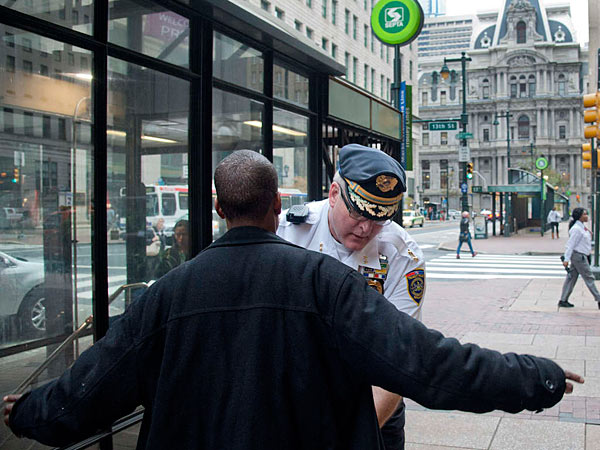
SEPTA Police Chief Tom Nestel frisks a man he suspected of selling tokens outside the entrance at the 12th Street station of the Market-Frankford El. (CLEM MURRAY / Staff Photographer)
Story Highlights
- Tom Nestel has embraced the new with his plunge into social media.
- The Philly cop’s snarky Twitter updates makes him a natural.
- He is on track of getting a doctorate in criminology next year at the University of Pennsylvania.



 Tom Nestel, the top cop at SEPTA, is a natural on Twitter.
"Rider complained about loud radio player on Rt66 each night. Tonight, undercover Transit Police pulled the cord on bus DJ," he tweeted on Oct. 23, adding the hash tag #silenceisgolden.
It's that dash of snark that makes some of his Twitter updates sparkle.
"Spiderman 'forgot' to pay at 46th St. He's paying now. . .#cheesesandwich. Can't outrun the radio and the cameras :-)" Nestel tweeted two days later, adding a photo of the offender's Spider-Man-style hoodie.
An imposing figure at 6 feet, 5 inches, Thomas J. Nestel 3d is a Philadelphia cop from a family of Philly cops. While rooted in tradition, he has embraced the new with his plunge into social media.
He also surprises: The 51-year-old Nestel is on track to earn a doctorate in criminology next year at the University of Pennsylvania, doing so while he oversees crime-fighting and antiterrorism efforts on one of the nation's largest transit systems.
His primary focus is on improving rider safety, but SEPTA is not rife with major crime. Transit police officers remain vigilant against unattended packages and sometimes deal with a highly publicized shooting or other violent attack, but what they encounter daily are quality-of-life offenses: disorderly conduct, public drunkenness, illegal vending, smoking.
Nestel started his job in August 2012, and his crackdown on quality-of-life offenses is reflected in SEPTA's crime statistics.
From Jan. 1 through Sept. 30 in 2012, there were 1,204 citations issued for quality-of-life violations.
For the same period this year, that number has spiked to 3,302 - a 274 percent increase.
The number of fare evaders caught has surged even more.
From Jan. 1 through Sept. 30 in 2012, 369 were hit with citations.
In 2013, that figure skyrocketed to 1,779 - a 482 percent jump.
Hopping a turnstile or slipping through the back door of a bus may seem like a minor transgression, but it is a defiant act often performed in front of paying, law-abiding customers. It's a mind-set that could indicate the offender is generally up to no good.
"Fare evader had hammer tucked in waistband. Kinda late for construction work. Transit Police probly prevented violent act. #cheesesandwich," Nestel tweeted at 9:04 p.m. Oct. 25.
The chief has heard complaints that he removed visible officers from some locations, but he said he removed them from where crime was already low or virtually nonexistent. "You put the cops where the problems are," he said.
The worst place in the system was the Somerset Station on the El in the heart of Kensington Avenue.
"It used to be like zombieland out here," said James Townsend, 24, who works at the mobile-phone store on the northeast corner of Kensington and Somerset Street.
The "zombies" were drug addicts who congregated around the station. Somerset was notorious.
"There's just no way to explain to a person that had never sat at Kensington and Somerset to understand how the people that frequented that intersection were zombies," Nestel said. "They weren't capable of communicating. They leaned forward at this odd angle and wouldn't fall over. It was just so bizarre the stuff that was going on there."
SEPTA cashiers felt so unsafe at Somerset they refused to accept overtime assignments there, Nestel said.
"The drug use was rampant. It was on the platforms. It was in the stairwells. Normal people that were trying to use the system would get offered drugs and needles. The prostitutes worked right on the corner and would take people up the steps to the El to do their business. It was complete lawlessness," he said.
About a year ago, Nestel had his detectives conduct surveillance to identify the "main drug characters" around Somerset. His officers talked to local business owners and residents. The officers offered drug-rehab referrals to the addicts and issued warnings about a looming police takeover.
Then the transit police descended on Somerset last November, and they have remained since.
"The people don't bother you like they used to," said Mary Seeger, 54, a rider from Northeast Philadelphia who uses the Somerset stop to visit family.
"It's good that they [the police] are doing their job," she said. "We need them to do their job."
"The cops are really cleaning this place up," said Jim Imbrenda, 87, whose family owns an appliance store on Kensington Avenue under the station.
However, Imbrenda has been around long enough to see crackdowns come and go. "You'll never get rid of the drugs," he said.
Nestel acknowledged that drug-related crime had been displaced, "so we're following it," he said.
"The next couple of stations, we have plainclothes operations, platforms and street level, for drug sales," he said.
After Somerset was secured, Nestel set his sights on the El station at 52d Street in West Philadelphia, which had more of a nuisance problem with vendors. His latest target is the Olney Transportation Center, which has a mix of crime and nuisance issues.
A married father of three, Nestel started his law enforcement career with SEPTA in 1982, a year after the transit agency formed its own police department. Before that, the system was covered by municipal police.
In 1985, Nestel decided to switch jobs. "I had always wanted to be a Philadelphia police officer," he said of his decision to join the force. He eventually rose to the rank of staff inspector.
The Philadelphia Police Department has been, Nestel likes to joke, "the family business."
Read more at http://www.philly.com/philly/news/20131104_From_a_police_dynasty__SEPTA_chief_embraces_the_new.html#t42VJ1mmB2OFcOoS.99


No comments:
Post a Comment